
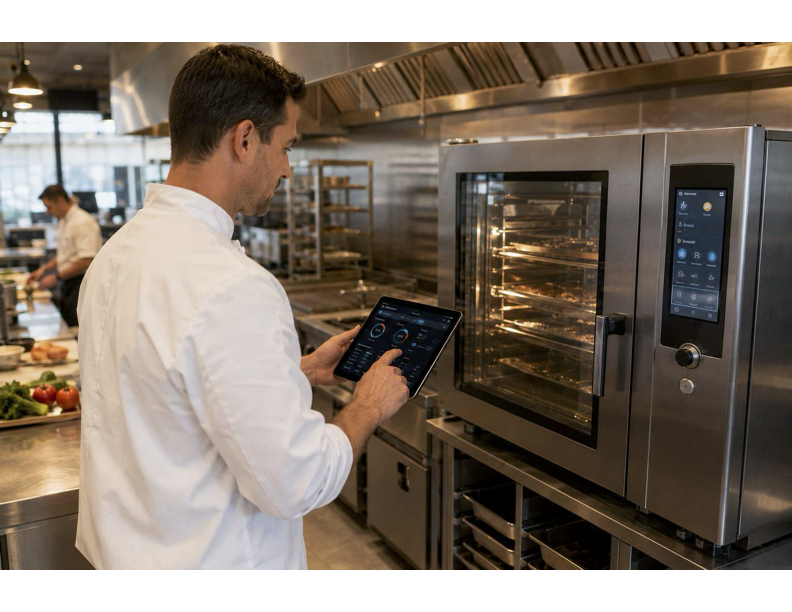
The commercial kitchen has evolved dramatically over the past decade. Rising labor costs, increasing customer expectations, and the demand for operational efficiency have encouraged restaurants, hotels, catering businesses, and institutional food service providers to embrace technology. Among the most significant innovations reshaping the industry are smart appliances.
Smart kitchen equipment combines advanced sensors, connectivity, automation, and data analytics to help operators improve productivity, reduce waste, and maintain consistent food quality. As technology becomes more accessible, smart appliances are quickly transitioning from a luxury investment to a competitive necessity.
What Are Smart Commercial Kitchen Appliances?
Smart appliances are connected pieces of equipment that can monitor performance, collect operational data, and communicate with users or other systems. These appliances often connect through Wi-Fi, Bluetooth, or cloud-based platforms, allowing managers and staff to control and monitor equipment remotely.
Examples of smart commercial kitchen appliances include:
- Intelligent ovens with programmable cooking settings
- Connected refrigeration systems that monitor temperatures in real time
- Smart dishwashers that optimize water and energy consumption
- Automated fryers with precise temperature controls
- Inventory management systems integrated with refrigeration units
- IoT-enabled coffee machines and beverage dispensers
These technologies help streamline daily operations while providing valuable insights into kitchen performance.
Benefits of Smart Appliances in Commercial Kitchens
Improved Operational Efficiency
One of the primary advantages of smart appliances is their ability to automate routine tasks. Automated cooking programs, predictive maintenance alerts, and remote monitoring reduce the need for constant manual oversight.
For example, a smart combi oven can automatically adjust temperature, humidity, and cooking time based on the food being prepared. This reduces human error and allows staff to focus on other essential responsibilities.
Enhanced Food Quality and Consistency
Consistency is critical in food service. Customers expect the same quality experience every time they visit a restaurant or order from a catering service.
Smart appliances help standardize cooking processes through programmable recipes and automated controls. Whether preparing meals at a single location or across multiple branches, operators can ensure uniform results with minimal variation.
Energy and Cost Savings
Commercial kitchens are among the most energy-intensive environments in any business. Smart appliances help reduce energy consumption by operating more efficiently and identifying opportunities for savings.
Connected refrigeration systems can detect temperature fluctuations before they become serious issues, while smart dishwashers optimize water usage based on load size. Over time, these efficiencies can significantly reduce utility expenses.
Predictive Maintenance and Reduced Downtime
Equipment failures can disrupt service, lead to food waste, and result in costly repairs. Smart appliances use sensors and diagnostic tools to monitor equipment health continuously.
When performance issues are detected, the system can send alerts before a breakdown occurs. This predictive maintenance approach helps operators schedule repairs proactively, minimizing unexpected downtime and extending equipment lifespan.
Better Food Safety Compliance
Food safety remains a top priority for commercial kitchens. Smart refrigeration units and temperature-monitoring systems provide continuous tracking and automated recordkeeping.
This data helps businesses maintain compliance with food safety regulations while reducing the risk of spoilage and contamination. Automated logs also simplify inspections and reporting requirements.
The Role of Data in Modern Kitchen Management
One of the most powerful aspects of smart appliances is the data they generate. Kitchen managers can access detailed reports on equipment performance, energy usage, cooking times, and maintenance schedules.
This information enables data-driven decision-making that can improve profitability and operational performance. Managers can identify inefficiencies, optimize workflows, and make informed equipment investment decisions based on actual usage patterns.
Challenges to Consider
While the benefits are substantial, adopting smart appliances requires careful planning.
Initial investment costs can be higher than traditional equipment. Staff training may also be necessary to ensure employees can effectively use new technologies. Additionally, businesses should evaluate cybersecurity measures and ensure their connected systems are properly protected.
However, for many organizations, the long-term savings and operational improvements outweigh these initial challenges.
Future Trends in Smart Commercial Kitchens
The future of commercial kitchens is increasingly connected and automated. Emerging technologies such as artificial intelligence, machine learning, and advanced analytics are expected to further enhance kitchen operations.
Future innovations may include:
- AI-powered cooking systems that adapt recipes automatically
- Advanced inventory tracking linked directly to supplier ordering
- Fully integrated kitchen management platforms
- Real-time performance optimization based on customer demand
- Enhanced sustainability features that further reduce waste and energy consumption
As these technologies continue to mature, smart kitchens will become more efficient, responsive, and profitable.
Conclusion
Smart appliances are transforming commercial kitchens by improving efficiency, consistency, food safety, and cost management. Through automation, real-time monitoring, and data-driven insights, these technologies empower food service operators to meet modern challenges while delivering exceptional customer experiences.
Businesses that invest in smart kitchen technology today are positioning themselves for greater operational success and long-term competitiveness in an increasingly technology-driven industry.