Choosing the correct hood size isn’t just a design choice—it’s essential for safety, performance, and ventilation compliance. Undersized hoods cause smoke overflow, grease buildup, and poor air quality. Oversized hoods waste energy and increase project costs. Here’s a simple guide to getting the sizing right.
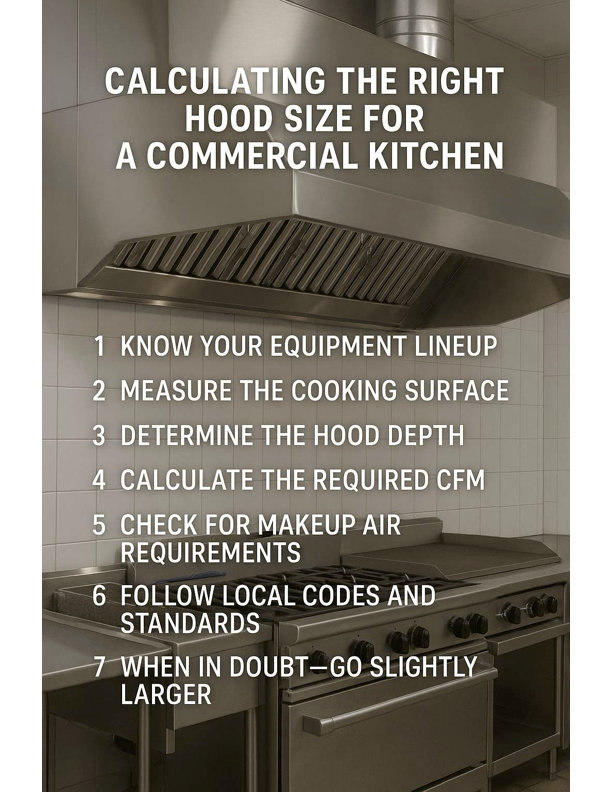
1. Know Your Equipment Lineup
Start by listing all appliances under the hood: fryers, ranges, griddles, charbroilers, ovens, or specialty high-heat units. Each one affects required airflow (CFM) and hood dimensions.
2. Measure the Cooking Surface
The hood must extend beyond the equipment:
-
At least 6 inches on the front.
-
At least 6 inches on each side.
Example: If your cooking line is 72" wide, the hood should be around 84" wide.
3. Determine the Hood Depth
Front-to-back sizing is usually based on hood type:
-
Wall-mounted canopy hoods: typically 48" deep.
-
Island hoods: often 54" deep.
This ensures the capture area can pull smoke and heat upward effectively.
4. Calculate the Required CFM
Different appliance types require different exhaust rates. General guidelines:
-
Light-duty equipment: ~150 CFM per linear foot
-
Medium-duty: ~300 CFM per linear foot
-
Heavy-duty / charbroilers: 400–600+ CFM per linear foot
Multiply by the hood width to estimate total airflow.
5. Check for Makeup Air Requirements
Every CFM exhausted must be replaced. Poor makeup air causes:
-
Drafts
-
Low capture
-
Comfort issues for staff
Balancing supply and exhaust is key for code compliance.
6. Follow Local Codes and Standards
NFPA-96, IMC, and local jurisdictions may have additional rules for:
-
Minimum overhangs
-
CFM requirements
-
Grease filter angles
-
Fire suppression clearance
Always confirm before finalizing the hood size.
7. When in Doubt—Go Slightly Larger
A hood that’s a bit wider captures heat and smoke more reliably, especially with high-heat appliances or long cook lines.
Final Thoughts
Getting the right hood size is a combination of appliance layout, ventilation needs, and safety codes. With accurate measurements and proper airflow calculations, you’ll ensure a cleaner, safer, and more efficient kitchen.